The Director Showdown: Kubrick vs. Nolan (What the Data Actually Says)
Everyone calls Christopher Nolan the heir to Stanley Kubrick’s throne. It’s an easy comparison: they both make "smart" blockbusters, they both obsess over technical precision, and they both leave audiences feeling cold and small in the face of massive concepts. But "feeling" similar isn't enough for me. I wanted to see the signal in the noise. I wrote a Python script to analyze their filmography frame-by-frame, pitting Kubrick (2001, The Shining, Full Metal Jacket) against Nolan (The Dark Knight, Interstellar, Inception). The data suggests that while they might arrive at the same destination, they are driving completely different vehicles.
Pacing: The Hypnotist vs. The Sprinter
We often confuse "long movies" with "slow editing." To separate the two, I plotted the Average Shot Length (ASL) and cut rates.
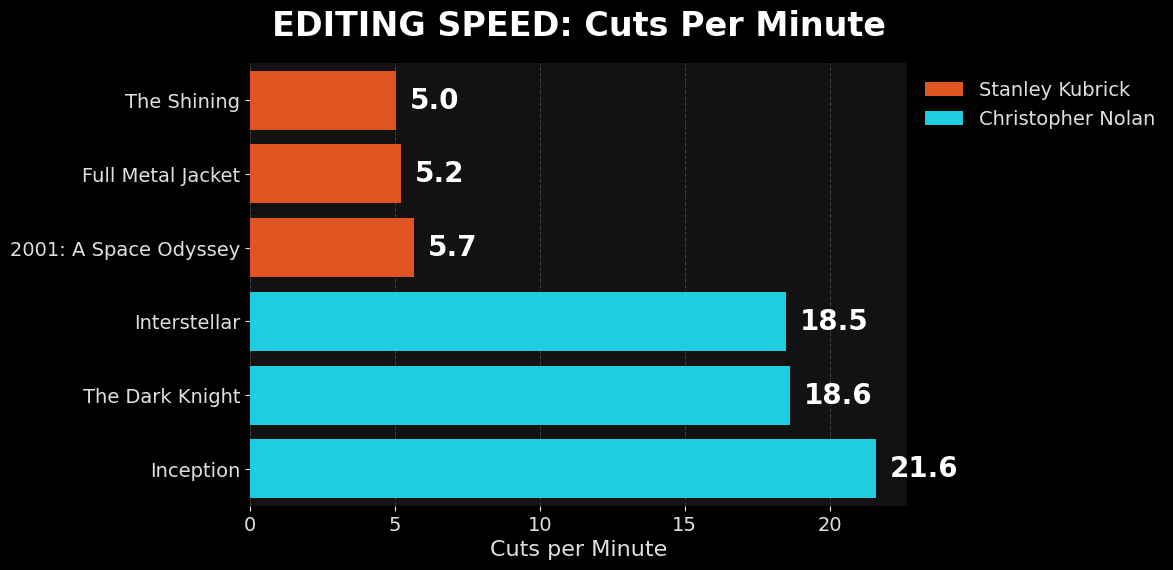
The difference here is aggressive.
-
Kubrick’s Stare: With films like 2001 and The Shining, Kubrick hovers around 5 cuts per minute. This isn't just "slow"; it's hypnotic. He forces you to inhabit the frame until it becomes uncomfortable. The tension comes from not cutting.
-
Nolan’s Pulse: Nolan is frantic. The Dark Knight hits nearly 18 cuts per minute. Even Inception—a film about the drift of dreams—clocks in at 15. Nolan builds tension through acceleration. He doesn't let you dwell; he forces you to keep up.
Kinetic Energy: Optical Flow
Using optical flow analysis, I measured the "pixel kinetic energy"—essentially, how much the camera (or the subject) moves from frame to frame.
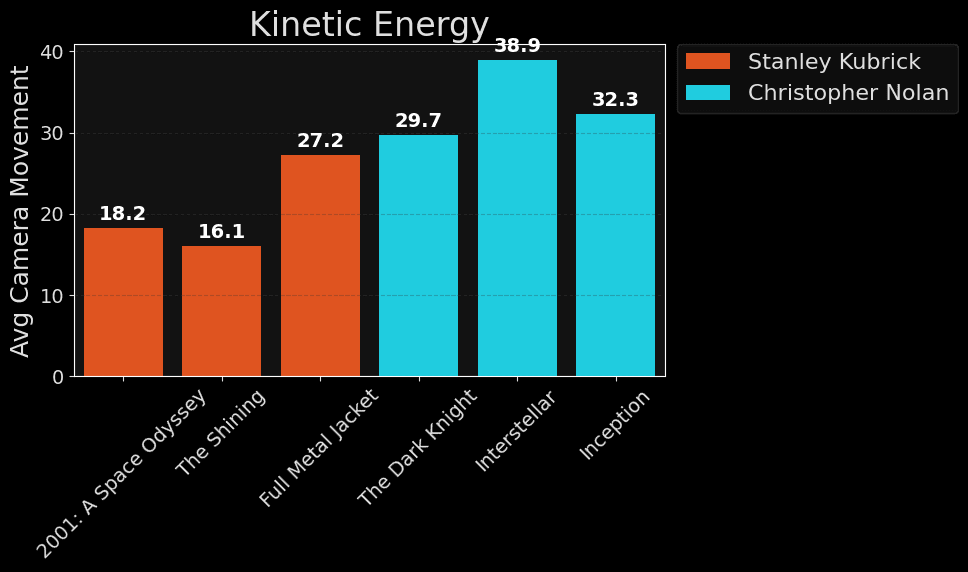
This metric defines their "vibe" more than anything else.
-
Nolan is Anxious: The data shows massive spikes in movement. His camera is handheld, floating, or chasing. He wants the viewer inside the action, experiencing the chaos subjectively.
-
Kubrick is Clinical: His line is flat. Even when the camera moves (like the famous steadicam hallway shots), it is smooth, mechanical, and stabilized. He observes his characters like rats in a maze. He keeps you at a distance.
The Palette: Who is the "Cold" One?
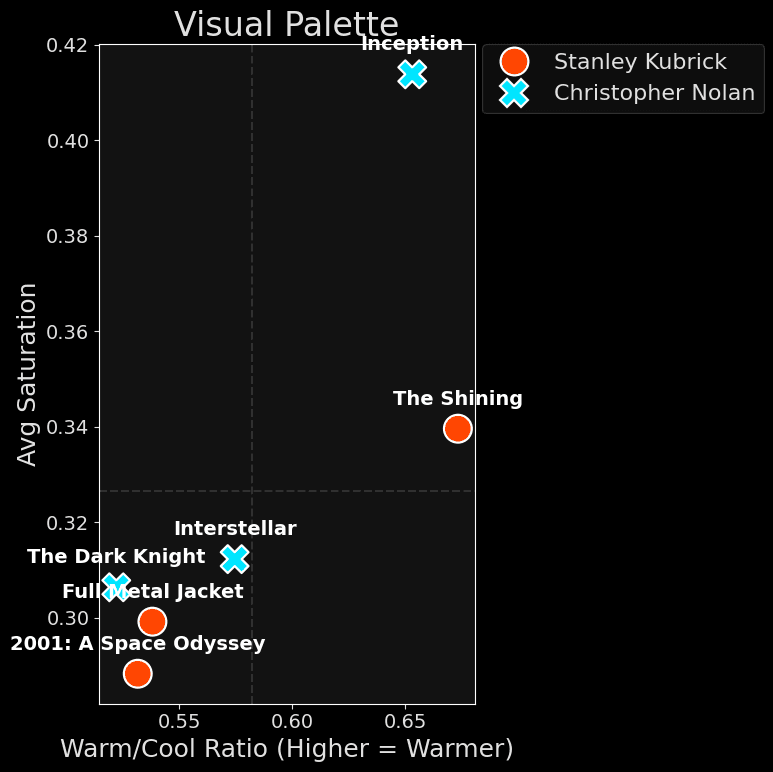
I plotted the Warmth vs. Saturation of every frame. The common criticism is that Kubrick is "cold" and "sterile," but the scatter plot tells a different story.
-
Kubrick is surprisingly warm: Look at the top right quadrant. The Shining and 2001 are saturated and full of reds and yellows. Kubrick uses color as a psychological weapon—bold, primary, and alarming.
-
Nolan is the cold one: His cluster is tight in the bottom left—desaturated teals, greys, and steel blues. Interstellar and The Dark Knight live in a grounded, metallic reality. He strips color away to make the impossible feel "realistic."
The Barcodes: Visual Structure
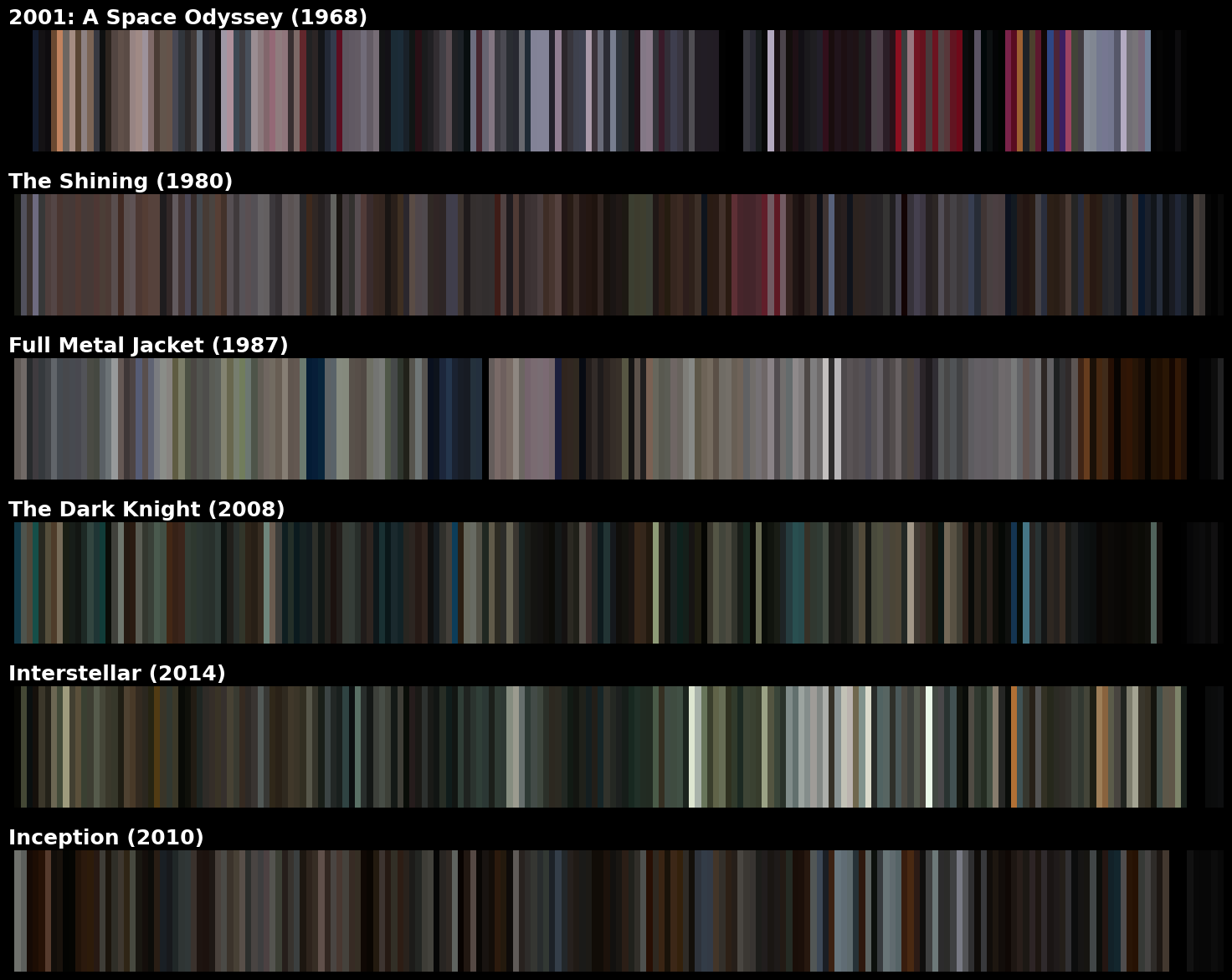
Finally, the movie barcodes (compressing frames into time-slices) reveal the architectural structure of the films.
-
2001: A Space Odyssey: You can see the distinct "movements" of the film—the black obelisk, the white sterile space station, and the explosion of color in the "Star Gate" sequence. It’s structured like a symphony.
-
Full Metal Jacket: A binary film. The cool, rigid blues of the barracks vs. the warm, chaotic oranges of Vietnam.
-
Inception: It’s a monolith of consistency. A steady wash of steel-grey and corporate browns, broken only by the white of the snow fortress. It is visually relentless.
The Verdict
The data proves that Nolan is not the new Kubrick.
Kubrick is a painter. He uses stillness, bold color, and composition to create a surreal nightmare that you have to sit in. Nolan is an engineer. He uses speed, desaturation, and constant motion to build a complex machine that overwhelms you.
They both want to blow your mind, but Kubrick does it by slowing your heart rate down, while Nolan does it by jacking it up.
Comments0
Log in to join the conversation.